Page History: Pre History Of Band Saws
Compare Page Revisions
Page Revision: 2008/04/05 11:24
The idea of the bandsaw dates back to at least 1809, when William Newberry received a British patent for the idea, but bandsaws remained impractical because of the blades. No-one could make a bandsaw blade that could withstand the constant flexing until Frenchman A. Perin introduced a viable blade in the early 1860s. By the late 1860s the blades had made their way to North America and the first manufactured bandsaws appeared.
Before that, though, there were a surprising number of patents as inventors either anticipated the eventual development of better blades, or were so impractical as not to notice that blades were not available. Check out some of these patents and then make up your own mind.
The
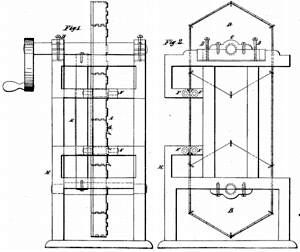
first American bandsaw patent was granted to Benjamin Barker of Ellsworth, Maine, in January of 1836. Barker patented the basic concept of the bandsaw. There was obvious prior art, but before July 1836 there was no review process for patent applications. Barker's machine used a blade 34 feet long, 9 inches wide, and one twelfth of an inch thick, or about the thickness of a thin-kerf circular saw blade. The wheel's diameter was five feet. Notice how the frame of the saw is not a C-frame but more of an I-frame. That reduces the saw's horizontal capacity by half, but with five-foot wheels it hardly matters.
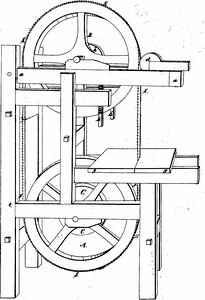
The
next bandsaw patent came along only a month later, granted to one William Cary of Poughkeepsie.
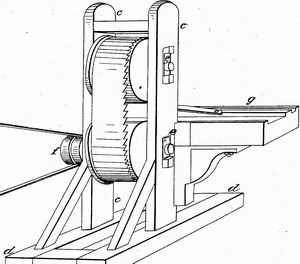
Wow. Just wow.
Given the problems with blades, some applied their throbbing brains to alternative approaches to making a continuous-cutting scrollsaw replacement.
Here's one solution from 1838:
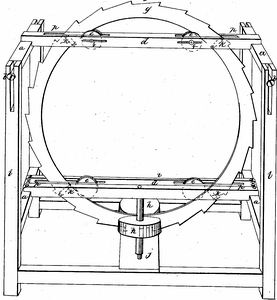
This type of saw was common enough to merit its own name: the annular saw. One was manufactured by Goodspeed & Wyman ca. 1870, just in time to be knocked off the market by the newly practical bandsaw.
After those two 1836 patents,
the next true bandsaw patent came in 1849, granted to rule maker and sawmill maker Lemuel Hedge. This design looks pretty normal. The saw has upper guides, albeit odd-looking.
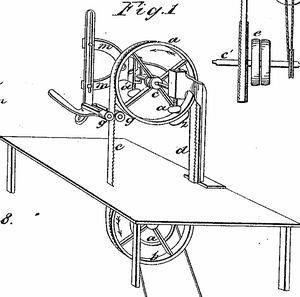
In 1857
Hedge's patent was reissued. Hedge was deceased by that time, and the reissued patent was assigned to William P. Wood and Samuel De Vaughan of Washington DC. We don't know anything about these guys other than the patents they were granted, but it is at least possible they manufactured the saw, otherwise why would they go to the expense of a reissue? Further research is warranted.
In 1851 Hedge received
another bandsaw patent, this time for a radically different design.
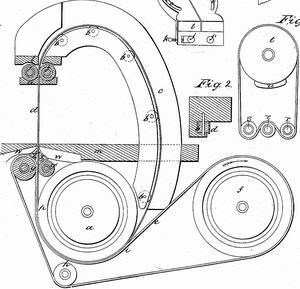
There are two odd things about this saw. First is the use of several small wheels instead of a single upper wheel. Second is the driving mechanism: a secondary belt wraps around the bottom of the lower wheel and drives the blade. The intent is to only tension the straight part of the blade that is in the cut; the rest of the blade is untensioned. Interesting, but a genetic dead end.
Another dead end is this
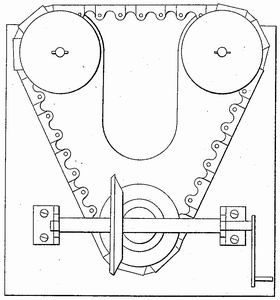
decidedly odd idea patented in 1858 by one Harvey Brown of New York City:
The "band" is made of a series of inflexible links with hinged joints. I don't understand how this saw could work. As the hexagonal wheels rotate, the blade is going to move back and forth laterally. There are upper and lower blade-guides but the geometry just does not work out.
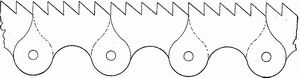
Next in our bandsaw freakshow is a bandsaw that uses a chainsaw blade,
patented in 1863 by New Yorker George Kammerl:
In 1866, New Yorker Paul Pryibil
patented some bandsaw features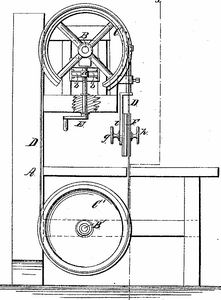
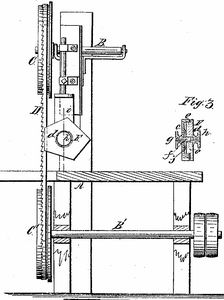
Pryibil's patent covered an upper blade guide design that looks rather impractical because it consumes too much vertical capacity. More importantly, the patent covered the use of a spring to make a yielding mount for the upper wheel. The patent's importance in itself is modest; there were more important bandsaw patents I skipped over because of insufficient entertainment value. But Pryibil's patent is notable because it is, so far as we know, the first patented bandsaw that actually saw commercial production.
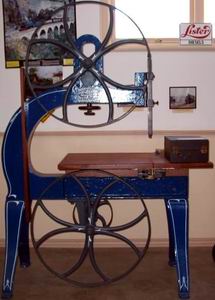
Although the saw above does not exactly match the patent drawing, it uses the patented features and carries the 1866 patent date.