Page History: Changing the Belt on a Walker-Turner 900 Drill Press
Compare Page Revisions
Page Revision: 2011/04/03 01:41
DEVELOPMENT AND EDITING IN PROCESS, PLEASE BE PATIENT
This page shows how the belt can be changed on a Walker-Turner 900 series drill press. These photos were taken during the process of a full restoration of a WT 936, which is a floor model drill press with a production table. The same process can be used on any 900-series machine.
Walker-Turner 900 drill presses used at least two different designs for the upper bearing retainer, on the top of the spindle pulley. One version uses a machined steel sleeve that slips snugly through the head casting from the top and captures the upper pulley bearing. One of these sleeves can be seen in the bottom right of the following parts photo.
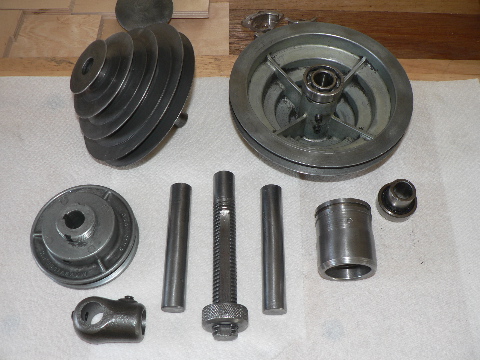 spindle sleeve on bottom right |
The other design, which is what exists on the machine used in this restoration and documentation, has an extended lower end of the spindle cap, which is a single piece that also serves as the upper bearing retainer. This type of spindle cap and bearing retainer can be seen in the upper portion of the following parts photo.
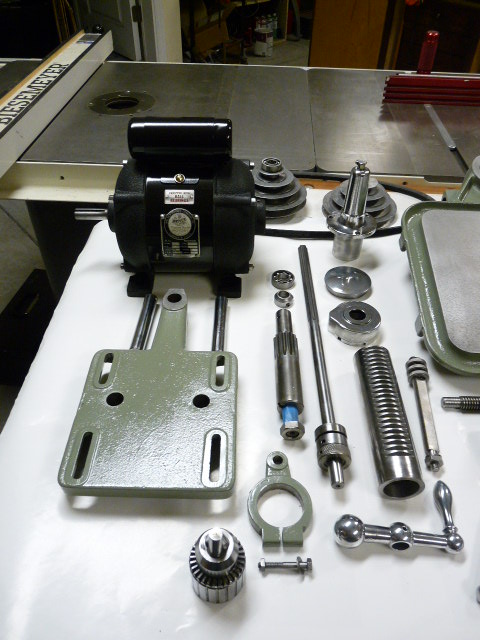 spindle cap and bearing retainer towards top |
A difficulty in the design of these drill presses, as well as other manufacturers', is that when the spindle is installed, the spindle pulley is fully captive within the head casting, so a belt cannot simply be slipped over the top of the spindle pulley for installation. Some users get around this difficulty by installing link belts on their drill presses, which can be decoupled at a link, slid around the pulley, and reattached. Others have been able to successfully install a v-belt through the opening on the top of the head casting with the spindle still intact.
The following approach, which shows how to drop the quill and spindle out of the head casting, takes about 15 minutes once you've done it a couple times and is what you would do if you're installing a belt as part of a broader machine restoration anyways.
Start by removing the return spring cover, shown below. Remove the machine screw that bolts the cover to the casting, making sure not to let the cover itself work loose from its stationary position snug against the head.
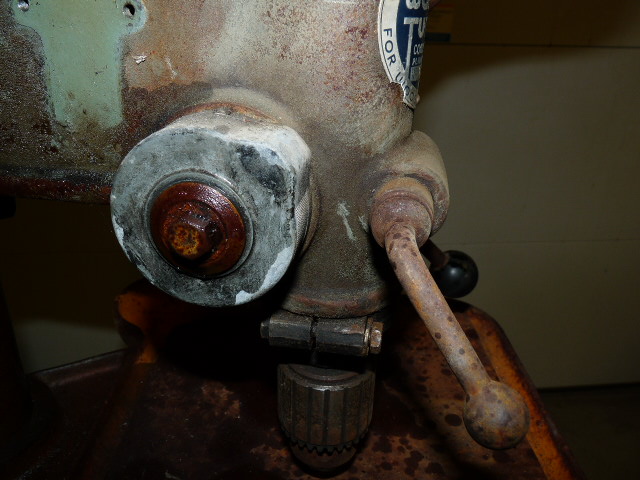 Unrestored return spring cover |